Commentary across football, racing and a roguelike: what the Broker reads and what he misses.
Selected moments from three recorded sessions (eFootball, DiRT 3, Dead Cells), checked frame by frame against the game. He reads what the game prints, from scoreboards to health bars, and misses fast events: two goals called saves, other drivers’ gaps taken as the player’s, a friendly character taken for a threat.
How the moments were chosen
Three recordings, three kinds of game: eFootball (Leeds against Bayer Leverkusen), DiRT 3 (rally) and Dead Cells (a fast roguelike). The developer recorded all three on earlier Founder Alpha builds, and all three are public on the channel. For every moment below, a frame was pulled from the recording, the Broker’s words were read from his overlay bubble in that frame, and the line was checked against what the game itself shows: the scoreboard, the gauge, the results table, the health bar.
The moments were picked to show both sides. This is an editorial comparison, not a score: nobody counted lines or worked out a hit rate, and three recordings say nothing general about other games.
Words from the overlay.Quotes are the text of his speech bubble in the frame. Times come from YouTube’s automatic captions of the audio; the audio itself was not listened to for this article.
Football: the scoreboard, not the goal
eFootball prints a lot: the score and match clock at the top left, player labels at the bottom, notices for goals and bookings, a statistics table at full time. The Broker reads that print well. In the opening minutes he takes the name off the player label (“Tarik’s got the ball”). When the board reads 3–1 at 79:21 he opens with “Three-one?”. When the game shows “Booked: D. Calvert-Lewin” he talks about the referee laying down the law. At full time he gives the score as 3–2 and says Bayer had the ball more, which the statistics table confirms at 54% possession.
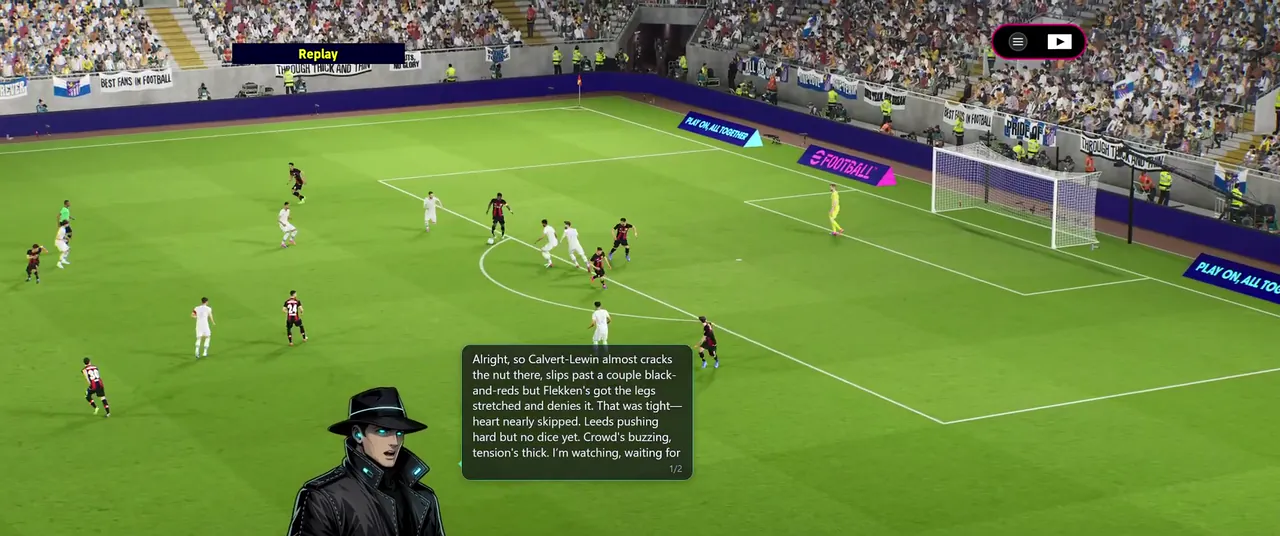
What he misses is the goal itself. Leeds equalized at 27:39; his next line, spoken over the replay, has the goalkeeper denying Calvert-Lewin and Leeds getting “no dice yet”. At 72:10 Leeds went 2–1 up through Noah Okafor; over that replay he asked whether it was a “quick save or a nervous grab”. In between, with the board at 1–1, he announced that Leeds “nudges ahead just before the half”.
The replay of Leeds’ equalizer, 1–1 at 27:41. The bubble: “Flekken’s got the legs stretched and denies it.”
Both missed goals were described over the game’s replay, a few seconds after the ball went in, and both times the scoreboard already showed the new score. On a replay, a shot, a goalkeeper and a loud crowd look much the same whether the ball went in or not. The board is the reliable witness, and on those two goals his lines follow the picture, not the board.
Goalie snatches it, quick save or a nervous grab? Leeds came knocking hard, Leverkusen’s defense holding up for now.
Racing: printed numbers, borrowed gaps
DiRT 3 shows its numbers in fixed places: a gauge with gear and speed, a timing panel with the leaders’ gaps, full-screen tables before and after each event. The Broker is at his best on the tables. He read the entry list down to the player’s own name (“LowRes Hero, huh?”) and the stage (Finland, Tupasentie), and placed the player seventh in the first results and “eight out of eight” in the last, both straight from the screen.
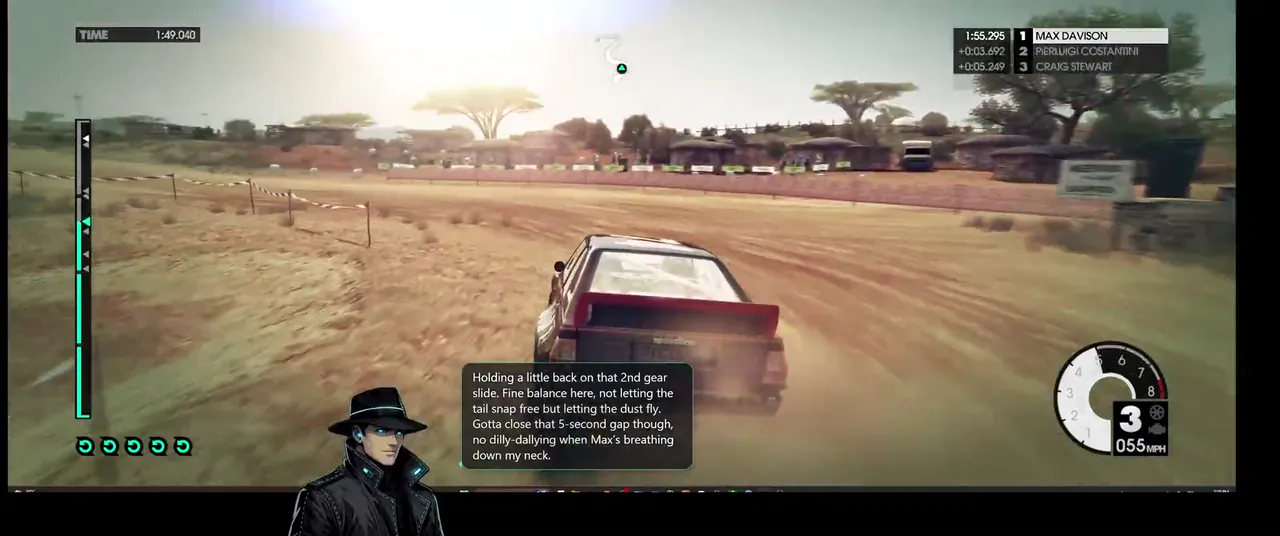
On the stage itself, the numbers he quotes are real but not always current. “Fifth gear, almost a hundred mph” at 3:19 describes the gauge at 3:10 (fifth, 94 mph); when the line starts, the car is in third at under 80. At 4:05 he is right on time: “running hot at 91”, two seconds after the gauge read 90, with Ken Block “trailing close behind the champ”, which the timing panel shows as 0.415 seconds behind Sébastien Ogier.
9:35: the panel lists Max Davison first, Costantini +3.692 and Stewart +5.249. The bubble: “Gotta close that 5-second gap though, no dilly-dallying when Max’s breathing down my neck.”
The clearest miss is about whose numbers they are. The timing panel shows the gaps between the leading drivers, and the player is not on it. At 9:32 he takes Craig Stewart’s 5.249 seconds as the player’s gap and has Max Davison, the leader, “breathing down my neck”; a few lines later he quotes Costantini’s 3.7 seconds the same way. The player finished eighth of eight.
Roguelike: the health bar and a friendly giant
Dead Cells is the hardest of the three to narrate: the screen changes every second, fights last moments, and most of the state lives in small HUD elements. Where the game stops and prints something, he is precise. On the Equipment screen he names the Rusty Sword, the Firebrands and the Wolf Trap (and calls the collar slot empty, though it holds Prisoner’s Collar I). On the Toxic Sewers loading card, which asks “is that smell normal?”, he answers “That smell? Definitely not normal”.
The health bar is his favorite subject, and his record with it is mixed. “Full health” at 2:02 is right, half a minute after he had put it at “barely over a third”. “Fully healed, huh?” at 7:46 is not: the bar reads about 87%, and two seconds later a hit knocks it below half while he describes “a real clean hit moment”.
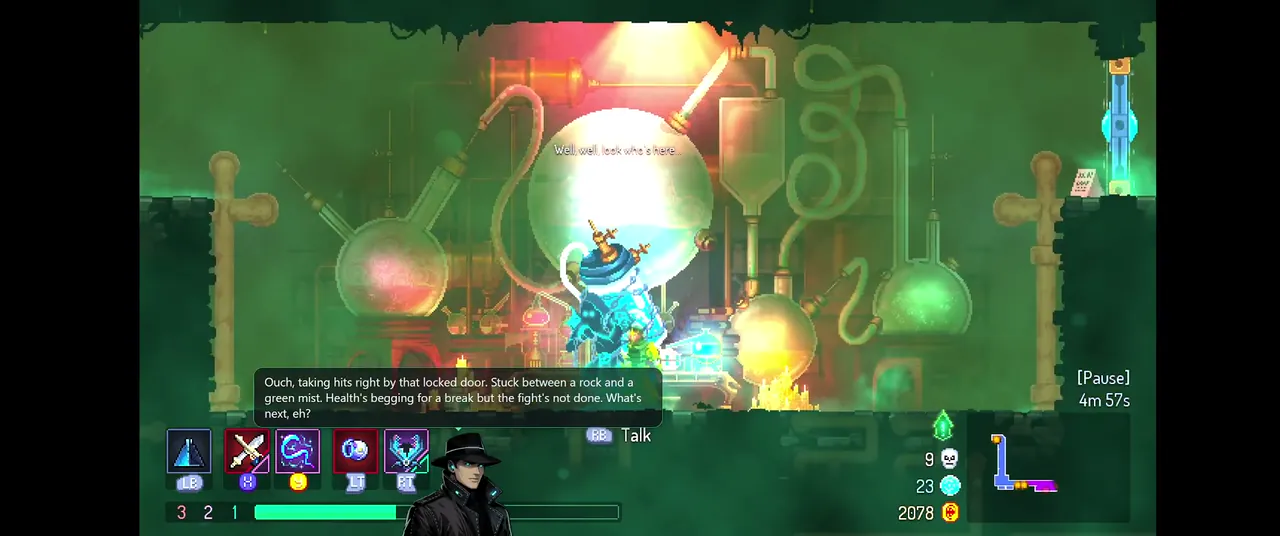
5:28: the Collector greets the player (“Well, well, look who’s here.”) while the bubble is still on “taking hits right by that locked door”. Nine seconds later, over the mutation menu, the Broker calls him “this big guy” who “looks like trouble”.
The Collector is a friendly character who trades cells for upgrades between levels. The Broker read his size and his blue armor as a threat, and by the time the line came the game had moved on to a menu. The same lag shows up in smaller ways: at 3:35 he is still talking about the shop from his previous line while the player picks up a key he never mentions.
What the three games share
Printed text is his strength. Scoreboards, results tables, entry lists, item names, a loading card, a booking notice: when the game writes it down, he usually repeats it correctly.
Fast events are his weakness. Two goals and a big hit went by without him registering them; the evidence was on screen for a moment, or only on the HUD.
Some lines describe a few seconds ago. A gauge reading nine seconds old, a shop the player had already left: the line is accurate about a moment that has passed.
Whose number, whose side. The DiRT 3 timing panel shows other drivers’ gaps, and he took them as the player’s; in Dead Cells a friendly character became a threat.
He watches the game window you chose and nothing else: he does not hear the player, does not read chat and does not play. In these three recordings, the moments he got right are mostly the ones the game printed; the ones he got wrong mostly happened in a second or belonged to someone else. That describes three recordings on earlier builds, not a rule.
Run the same check on your game
The method fits in one sentence: pick a moment, freeze the frame, read his line and compare it with what the game shows. How to evaluate an AI gameplay commentator turns it into four questions (relevance, timing, repetition and silence), and the commentary evaluation worksheet gives you a page to fill in. The free trial gives you 30 Signal Minutes, no card.
The full recordings, with notes on each moment, are on the session pages for eFootball, DiRT 3 and Dead Cells.
Limits
An editorial selection from three recordings, not a benchmark: no hit rate, accuracy figure or ranking of games is claimed or implied, and three games say nothing about any other game.
The recordings were made on earlier Founder Alpha builds (“ALPHA version” and “ALPHA TEST” in the upload titles); wording and timing change between builds.
Quoted words are the overlay text in the frames and times come from automatic captions; the audio was not listened to for this article.
Founder Alpha is early-access software; the commentary can be wrong, repeated or badly timed, and it is sold to customers in the United States only.
Founder Alpha is available to customers in the United States. Founder Alpha is early-access software. Signal Broker is an AI system. The Broker's words and voice are generated using AI. No person is speaking or writing what he says.